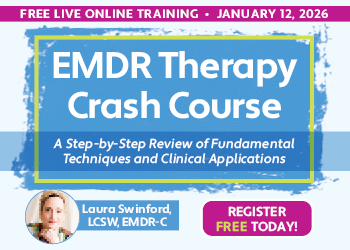
PESI offers several free training courses every year on the
most current and effective approaches in therapy. It's our way of giving back to our community of
clinicians who are doing such important work in the world.

Whether you’re a newcomer eager to take a closer look at EMDR therapy or a seasoned practitioner searching for a revitalizing refresher, this FREE training is for you!
Dive in with Certified EMDR Clinician and trainer Laura Swinford as she shares overviews of every phase of EMDR - using each session to transform the “whys” of EMDR into clear and logical explanations, making the entire process more comprehensible.
More importantly, she’ll bring the “hows” of EMDR within your reach in a way that’s easy enough for beginners to get their footing, yet packed with enough specifics, techniques, and tips to reinvigorate seasoned practitioners.
When you register for free today, you’ll get:
- 1 full day of live expert-led training (a $249.99 value)
- On-demand access to the recording for 14 days*
- Interactive Q&A
- The complete set of course materials
- CE upgrades available
Register today!
Register for
FREE Today!
Can't attend live? Register anyway for
14-day free access to the training!
*CE credit and certification is available for
an additional cost. Register for more information.
By registering, you agree to our Terms of Use, Privacy Notice, and if applicable, our Event Terms.
Free Live Online
Training
EMDR Therapy Crash
Course:
A Step-by-Step Review of Fundamental Techniques and Clinical Applications
A Step-by-Step Review of Fundamental Techniques and Clinical Applications
Presented by Laura Swinford,
LCSW, EMDR-C
January 12th from 10:00 AM to 6:00 PM Eastern
January 12th from 10:00 AM to 6:00 PM Eastern
Can't attend live? Register anyway for
14-day free access to the training!
*After you register, upgrade to receive
up to 12.5 CE hours including 6.25 live CE hours and 6.25 self-study CE hours.
Led by Laura Swinford, LCSW, EMDR-C this training is packed with so many valuable tools that you’ll leave eager to get out there and use what you’ve learned with clients right away!
Designed for counselors, social workers, psychologists, addiction counselors, marriage and family therapists, and other mental health professionals…
You’ll discover:- The keys to getting the most out of EMDR history taking
- Specific EMDR techniques that can be used to prepare clients for treatment
- How to work with complex trauma
- Ways to address blocked trauma processing
- The correct way to close and re-open an EMDR therapy session
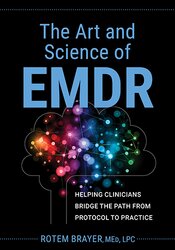
PLUS, you’ll have the chance to take your experience to the next level by purchasing one of the CE upgrade packages that includes your CE credits, a copy of the book The Art and Science of EMDR: Helping Clinicians Bridge the Path from Protocol to Practice, and a bonus training worth 6.25 CE hours from speaker Arielle Schwartz, PhD, CCTP-II, E-RYT, EMDR-C, “EMDR & Parts Work for Treating Complex Trauma: Somatic Techniques to Decrease Defensiveness and Facilitate Trauma Processing”!
Don’t wait to get the fundamental and practical skills you need to implement EMDR techniques with confidence.
Register for FREE today!

Meet Your
Speaker!

Laura Swinford, LCSW, EMDR-C, is certified in EMDR, trains therapists as part of PESI’s 6-month EMDR Certification Program and provides EMDR consultation. She works as a therapist in a group private practice specializing in the treatment of trauma using EMDR, Ego State Therapy and Somatic Experiencing®. She has been certified in EMDR for nearly a decade and has used it with clients over that span to help them better process their past traumas and increase their ability to identify and cope with destructive emotions. She has more than 15 years of clinical experience and is also a published author of research work in the mental health field. Ms. Swinford previously served as an adjunct professor at University of Illinois Champaign-Urbana, where she taught evidence-based treatment to master’s level students. Ms. Swinford believes in connection and relationship as she journeys through life. She brings this approach to her work, matching techniques to the needs of her clients.
Click here for information about Laura SwinfordSign Up for the Exclusive
Upgrade Package
Take your event experience to a new level with our exclusive upgrade package that includes CE credit, The Art and Science of EMDR: Helping Clinicians Bridge the Path from Protocol to Practice book and as an added BONUS get access to Arielle Schwartz’s training “EMDR & Parts Work for Treating Complex Trauma: Somatic Techniques to Decrease Defensiveness and Facilitate Trauma Processing” for free!
A $524.97 value...
today just $99.99!
Live Upgrade Package
✔ Up to 6.25 LIVE CE hours
✔ Up to 6.25 self-study CE hours
✔ 14-day recording access
✔ The Art and Science EMDR book
✔ a FREE bonus training from speaker Arielle Schwartz, PhD, CCTP-II, E-RYT, EMDR-C, EMDR & Parts Work for Treating Complex Trauma!
✔ Up to 6.25 LIVE CE hours
✔ Up to 6.25 self-study CE hours
✔ 14-day recording access
✔ The Art and Science EMDR book
✔ a FREE bonus training from speaker Arielle Schwartz, PhD, CCTP-II, E-RYT, EMDR-C, EMDR & Parts Work for Treating Complex Trauma!
Self-Study Upgrade Package
✔ Up to 12.5 self-study CE hours
✔ Unlimited recording access
✔ The Art and Science EMDR book
✔ a FREE bonus training from speaker Arielle Schwartz, PhD, CCTP-II, E-RYT, EMDR-C, EMDR & Parts Work for Treating Complex Trauma!
✔ Up to 12.5 self-study CE hours
✔ Unlimited recording access
✔ The Art and Science EMDR book
✔ a FREE bonus training from speaker Arielle Schwartz, PhD, CCTP-II, E-RYT, EMDR-C, EMDR & Parts Work for Treating Complex Trauma!
Please Note: There will be a 70-minute lunch and two 10-minute breaks; one in the morning and one in the afternoon. Lunch and break times will be announced by the speaker and at their discretion. A more detailed schedule is available upon request.
About The Art and Science of
EMDR a $24.99 value, included with your
purchase
The EMDR model is linear – real EMDR is not.
Therapists who are trained in EMDR can facilitate healing in the most profound ways. But successful treatment requires more than following a rigid script or a protocol. It requires bringing both the art and science of EMDR into the therapy room. In The Art and Science of EMDR, clinicians will learn how to do just that. Grounded in the principles of neurobiology and the science of deliberate practice, this book teaches both new and seasoned EMDR clinicians how to apply the phase-based model of EMDR in a more holistic way. Instead of conceptualizing EMDR in an inflexible and linear manner, clinicians will learn how to adapt the protocol to each client’s needs while maintaining authenticity to the model (and to who they are as therapists and humans).
Whether you are an EMDR trainer, consultant, or practitioner, this user-friendly guide will help you:- Understand a client’s presenting problems through the lens of neuroscience
- Identify and overcome common mistakes during preparation and resourcing
- Individualize a client’s inner resources
- Develop regular mindfulness habits that improve client outcomes
- Stay in control of the protocol while bringing more flexibility to the assessment phase
- Set the groundwork for effective processing and learn when and how to intervene
- Bring the principles of deliberate practice to EMDR trainings and consultations
Powered
By...

Our goal at PESI Inc. is simple… connect knowledge with need. And over the last few years, thanks to the generosity of our expert speakers, authors, and the support of therapists like you, we've had the amazing opportunity to provide professional training to more therapists than ever FOR FREE.
Join Laura Swinford, LCSW, EMDR-C at this completely free event today and take the knowledge and insight you learn into your next session. This event is our way of supporting you and your clients.
Schedule for the Day
All times are US Central
10:00 - 11:45am | Program opening & morning sessions
11:45 - 11:55am | Morning Break*
11:55 - 12:50am | Morning Session (cont.)
12:50am - 2:00pm | Lunch Break*
2:00 - 4:00pm | Afternoon Session
4:00 - 4:10pm | Afternoon Break*
4:10 - 6:00pm | Afternoon Session (cont.) & Closing
Please note: Each day there will be a 70-minute lunch and two 10-minute breaks; one in the morning and one in the afternoon. Lunch and break times will be announced by the speaker and at their discretion. A more detailed schedule is available upon request.
Learning Objectives
- Examine the Adaptive Information Processing (AIP) Model and its relevance to EMDR therapy.
- Evaluate the empirical evidence supporting Eye Movement Desensitization and Reprocessing (EMDR) therapy as an effective treatment intervention for posttraumatic stress disorder (PTSD).
- Identify contraindications for utilizing EMDR therapy for trauma treatment.
- Utilize direct questioning techniques to gather comprehensive client information during the history-taking phase.
- Integrate the development and installation of internal and external resources during EMDR therapy.
- Identify target memories and negative cognitions for desensitization and reprocessing.
Free Live Online
Training
EMDR Therapy Crash
Course:
A Step-by-Step Review of Fundamental Techniques and Clinical Applications
A Step-by-Step Review of Fundamental Techniques and Clinical Applications
Presented by Laura Swinford,
LCSW, EMDR-C
January 12th from 10:00 AM to 6:00 PM Eastern
January 12th from 10:00 AM to 6:00 PM Eastern
Can't attend live? Register anyway for
14-day free access to the training!
*After you register, upgrade to receive
up to 12.5 CE hours including 6.25 live CE hours and 6.25 self-study CE hours.
Here's a peek at what you'll
learn:
EMDR Foundations and Fundamentals
- AIP Model overview
- The basic components of memory
- The role of maladaptively stored information
- Bilateral Stimulation: eye movements, tapping, auditory and more
- Client readiness, ensuring safety and liability factors
- Research, risks and limitations
History Taking Gems: How to Get the Most Out of
Phase 1
- Comprehensive focused vs. symptom focused approaches
- Memory networks
- Float Back Technique and connecting present problems to past events
- Affect scan strategies to get to touchstone events
- Direct questioning techniques
- Treatment planning worksheet
Preparation and Resource Essentials for Phase
2
- EMDR state change strategies
- Containment
- Safe place
- Resource development and installation
- Resource team and conference room
Assessment, Desensitization and Installation: What
to Do and What to Avoid in Phases 3, 4 and 5
- Identify the target and image
- Negative and positive cognitions
- The clinician’s role
- Check-in points
- What to avoid
- Working with negative material that arises
- Checking SUDS, positive cognitions and VOC
- Adding BLS
The Body Scan, Closure and Re-evaluation: Finishing
Strong in EMDR Phases 6 - 8
- Clearing the body of residual distress
- Closing an incomplete target
- Closure and the “new truth”
- Assess the effect of processing
- Top questions for re-evaluation
- Re-engaging incomplete targets
Additional EMDR Strategies: Blockages, Interweaves
and More
- Address and overcome blocked processing challenges
- Cognition interweaves and knowing when to use them
- Techniques for effectively working with beliefs that may hinder processing
- Incorporate interweaves for somatic experiences
Free Live Online
Training
EMDR Therapy Crash
Course:
A Step-by-Step Review of Fundamental Techniques and Clinical Applications
A Step-by-Step Review of Fundamental Techniques and Clinical Applications
Presented by Laura Swinford,
LCSW, EMDR-C
January 12th from 10:00 AM to 6:00 PM Eastern
January 12th from 10:00 AM to 6:00 PM Eastern
Can't attend live? Register anyway for
14-day free access to the training!
*After you register, upgrade to receive
up to 12.5 CE hours including 6.25 live CE hours and 6.25 self-study CE hours.
Frequently Asked
Questions
This event is free to attend, however, if you would like to
earn CE credit, be sure to click the "Add CE" tab in your portal after registering. Enter your
credit card information and complete the upgrade to become eligible to earn CE for attending this
event. It's that easy!
Yes! This training is designed for:
- Counselors
- Social Workers
- Psychologists
- Marriage and Family Therapists
- Nurses
- Other Mental Health Professionals
If you would like to be a part of this event but you are
unable to attend live, you can sign up for free and receive 14 days of access to the event
recordings to watch on your own or purchase the self-study version of the summit to complete
whenever is most convenient for you and earn up to 12.5 CE credits!
Yes, you will have the opportunity to ask questions and
interact with Laura Swinford, LCSW, EMDR-C live during the training. This ensures you get the most
out of this
educational experience.
There is no obligation or commitment required when registering
for the free training. It's an opportunity for you to learn and explore IFS therapy strategies at no
cost.
Event
Countdown
0
Days
:
0
Hours
:
0
Minutes
:
0
Seconds
Free Live Online
Training
EMDR Therapy Crash
Course:
A Step-by-Step Review of Fundamental Techniques and Clinical Applications
A Step-by-Step Review of Fundamental Techniques and Clinical Applications
Presented by Laura Swinford,
LCSW, EMDR-C
January 12th from 10:00 AM to 6:00 PM Eastern
January 12th from 10:00 AM to 6:00 PM Eastern
Can't attend live? Register anyway for
14-day free access to the training!
*After you register, upgrade to receive
up to 12.5 CE hours including 6.25 live CE hours and 6.25 self-study CE hours.