Please wait ...

Women and girls with ADHD are frequently underdiagnosed and misdiagnosed, often presenting with anxiety, burnout, perfectionism, or relational distress rather than classic ADHD symptoms. Strengths such as creativity and sensitivity can mask underlying attentional and regulatory challenges, leading to years of invalidation and ineffective care.

This certificate training introduces the W-CAT Model (Women-Centered ADHD Treatment) — a neurodiversity-affirming clinical framework and treatment model that guides assessment, planning, and intervention across the lifespan. W-CAT provides a structured yet flexible roadmap that addresses the developmental, hormonal, neurobiological, and psychosocial realities of ADHD in women.

Rather than teaching a single modality, W-CAT shows clinicians how and when to integrate evidence-based approaches — including CBT-ADHD, ACT, IFS- and compassion-informed work, DBT-informed skills, somatic, expressive, and group-based interventions — across its core pillars. Participants leave with practical assessment language, regulation and executive function tools, and strategies they can immediately apply in clinical practice.

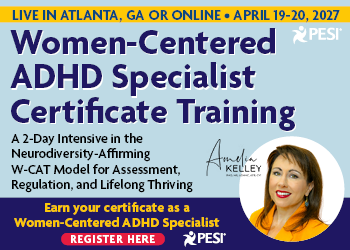
Women-Centered ADHD Specialist Certificate Training:
A 2-Day Intensive in the Neurodiversity-Affirming W-CAT Model for Assessment, Regulation, and Lifelong Thriving

April 19–20, 2027 | 8am–4pm ET

Limited Time Offer - Register by 4/1/27 and save!

Live in Atlanta, GA
Atlanta Marriott Northwest at Galleria
Limited in-person seats available

Breakfast & lunch both days, plus coffee & refreshments
Ask Dr. Kelley your questions in the room
Network with clinicians building the same niche
Free on-site parking
Full W-CAT certificate of completion
Earn up to 12.5 CE hours
90-day replay access

$499.99 $359.99
Can’t Attend In-Person?
Join Us Live Online!
Attend From Anywhere!

Ask Dr. Kelley questions directly, in real time
Virtual networking with clinicians in the same niche
Downloadable manual, worksheets & scripts
Full W-CAT certificate of completion
Earn up to 12.5 CE hours
90-day replay access


$459.99 $299.99
Click here to register as the coordinator for the in-person event.

Earn up to 12.5 CE Hours! Credit details | Click here for virtual CE credit details

Can't attend these dates? Order the self-study version here!

Risk-Free Registration · 100% Satisfaction Guaranteed
Two Days, Thirteen Modules, One Complete Model


DAY 1: FOUNDATIONS + IDENTIFICATION + REGULATION

Module 1: Rethinking ADHD in Women

W-CAT Pillar: Diagnostic Clarification & Unmasking

  • ADHD as a neurodevelopmental condition with early-origin differences in attention, regulation, and executive functioning
  • ADHD as a spectrum of neurodevelopmental traits
  • Gendered presentation patterns and masking behaviors
  • The Neurodiversity Bell Curve Model
  • Heritability of ADHD and epigenetic markers
  • Why women present with burnout, anxiety, and shame rather than classic ADHD
  • ADHD-related trauma and cumulative misattunement
  • Research gaps and emerging findings in women’s ADHD

Clinical Skills

  • ADHD-informed assessment framing
  • Language shifts that reduce shame and misdiagnosis

Module 2: Misdiagnosis, Comorbidity & Proper Assessment

W-CAT Pillars: Diagnostic Clarification & Unmasking; Psychoeducation & Empowerment

  • Underdiagnosis in girls and women
  • Overlap with anxiety, depression, trauma, BPD traits, substance abuse and sensory sensitivity
  • Differential diagnosis: ADHD vs trauma vs mood disorders
  • Functional impairment, societal pressure and invisible labor
  • Assessment tools and referral pathways

Clinical Skills

  • ADHD-informed intake questions
  • Review gold standard assessments
  • Strength based model of assessment
  • Limitations and Risk: Avoiding clinical pitfalls and pathologizing adaptive coping strategies

Module 3: Neurobiology, Motivation & Hormones

W-CAT Pillar: Adaptive Capacity, Hormonal Context & Growth-Oriented Planning

  • Dopamine, norepinephrine, and executive functioning
  • Motivation collapse vs “laziness”
  • Hormonal influences: menstruation, PMDD/PME, postpartum, perimenopause, menopause
  • Capacity shifts across the lifespan
  • Medication as neurochemical capacity support (stimulant and non-stimulant overview; access to executive function, not motivation)

Clinical Skills

  • Psychoeducation clients understand and retain
  • Normalizing fluctuating capacity without lowering expectations

Module 4: Nervous System Regulation & Embodied Therapies

W-CAT Pillar: Embodied Regulation & Nervous System Stabilization

  • ADHD as a regulation vulnerability rather than a willpower problem
  • Polyvagal-informed ADHD treatment
  • Somatic-informed ADHD treatment
  • Sensory processing differences
  • Shutdown vs avoidance
  • Burnout physiology

Somatic & Embodied Skills

  • Orienting and grounding
  • Resourcing and pacing
  • Movement-based regulation
  • Matching strategies to attentional profiles
  • Using bottom-up somatic interventions (movement, sensation tracking, paced activation) to support regulation, attention, and burnout recovery
  • DBT-informed distress tolerance and grounding skills to stabilize attentional overwhelm, emotional flooding, and shutdown
  • Limitations and Risks of somatic and embodied skills

Module 5: Strengths-Based Reframing & Identity Repair

W-CAT Pillar: Self-Compassion, Relational Repair & Strength-Based Identity

  • ADHD strengths research
  • Growth mindset and identity repair
  • Shame as a treatment barrier
  • Why strengths-based approaches improve mental health outcomes
  • Risks of deficit-only frameworks

Clinical Skills

  • Strengths-based formulation
  • Empowerment-oriented goal setting
  • Introducing parts-informed and compassion-based frameworks to reduce shame and support identity repair
  • Using expressive writing, narrative, or art-based exercises to support strengths discovery and identity reconstruction

DAY 2: TREATMENT APPLICATION + LIFE DOMAINS

Module 6: Empowerment-Centered Therapy

W-CAT Pillar: Psychoeducation & Empowerment

  • Neurodiversity-affirming treatment stance
  • Internalized ableism and chronic self-doubt
  • Boundary repair and voice reclamation
  • Unmasking vs unsafe disclosure

Clinical Skills

  • Reframing ADHD narratives to reduce shame and increase agency
  • Coaching clients in boundary language, disclosure decisions, and self-advocacy

Module 7: Executive Function Coaching & Daily Mastery

W-CAT Pillar: Executive Function Coaching & Skill Acquisition

  • Executive function load and invisible labor
  • Time blindness, initiation, sequencing
  • ADHD-friendly systems
  • Technology as support rather than control

Clinical Skills

  • Externalizing executive functions through scaffolds, cues, visual systems, and effective life “props”; interpersonal effectiveness skills (grounding to reduce interruption, tracking personal details and dates)
  • Teaching task initiation, time estimation, and sequencing using capacity-based planning

Module 8: Medication, Supplements & Integrative Care

W-CAT Pillars: Adaptive Capacity, Hormonal Context & Growth-Oriented Planning; Executive Function Coaching & Skill Acquisition

  • Stimulants and non-stimulants (therapist-appropriate overview of mechanisms, not prescribing)
  • Hormonal influences on medication response and side effects
  • Supplements with evidence, limitations, and placebo considerations
  • Lifestyle and circadian inputs affecting executive function (sleep, timing, stimulation)
  • Limitations and Risks involved in the therapist role and boundaries

Clinical Skills

  • Tracking intervention response (medication, supplements, lifestyle) in relation to hormones, stress, and sleep
  • Supporting medication follow-through through executive-function scaffolding (routines, cues, habit pairing)
  • Exploring barriers to medication use (side effects, identity concerns, prior experiences) without judgment
  • Translating client-reported patterns into clear, collaborative communication with prescribers

Module 9: ADHD, Impulsivity & Substance Use Risk

W-CAT Pillars: Embodied Regulation & Nervous System Stabilization; Executive Function Coaching & Skill Acquisition

  • Reward pathway dysregulation and self-medication
  • Increased legal, financial (ADHD tax), health, and safety risks associated with untreated ADHD
  • Substance use and behavioral risk across the lifespan
  • Shame, relapse cycles, and cumulative consequence load

Clinical Skills

  • Identifying impulsivity-driven risk patterns, consequence blind spots, and early warning signs
  • Teaching regulation through measured stimulation and alternative reward pathways (e.g., structured physical activity, intensity-matched exercise, time-limited novelty) to reduce reliance on substances or high-risk behaviors along with DBT-informed impulse interruption and urge-surfing strategies to reduce high-risk behaviors and relapse cycles

Module 10: Hormones, Cycles & Lifespan Planning

W-CAT Pillar: Adaptive Capacity, Hormonal Context & Growth-Oriented Planning

  • Cycle tracking and symptom patterning as a planning tool 
  • Puberty, postpartum, perimenopause, and menopause as neurodevelopmental transition points
  • Pregnancy, postpartum, and fertility-related medication planning considerations (coordination, risk–benefit framing, not prescribing)
  • Hormone replacement therapy (HRT) and its potential impact on attention, mood, and executive functioning
  • Anticipatory vs reactive treatment and life planning
  • Normalizing cyclical capacity rather than expecting linear performance

Clinical Skills

  • Guiding clients in cycle-aware capacity forecasting (energy, focus, emotion, load)
  • Supporting values-aligned planning conversations around pregnancy, postpartum, and menopausal transitions in collaboration with medical providers
  • Adjusting expectations, pacing, and supports across hormonal transitions

Module 11: Relationships, Masking & Rejection Sensitivity

W-CAT Pillar: Self-Compassion, Relational Repair & Strength-Based Identity (with community as a healing context)

  • Rejection sensitivity and emotional intensity and using parts-informed language to work with protector strategies, and relational reactivity 
  • Masking costs in intimacy, work, and community settings
  • Communication, rupture, and relational repair
  • Social load, comparison, and relational burnout in ADHD

Group Work & Community Repair

  • Therapeutic group work as a corrective relational experience (normalization, mirroring, reduced shame)
  • Benefits of ADHD-informed groups: decreased isolation, increased self-trust, and identity repair
  • Group formats and frameworks (process-oriented, skills-based, psychoeducational, hybrid)
  • Limitations and Risks of group work (ie. confidentiality, secondary trauma)

Navigating Social Pitfalls

  • Over-disclosure, under-disclosure, and safety calibration
  • Rejection sensitivity amplification in groups and online spaces
  • Boundary setting, pacing connection, and recovering from social misattunement

Clinical Skills

  • Helping clients recognize and interrupt rejection sensitivity spirals in individual and group contexts
  • Teaching needs-based communication, repair, and boundary language across relationships
  • Facilitating ADHD-informed groups with attention to safety, pacing, and inclusion while using DBT-informed interpersonal effectiveness skills to support boundaries, repair, and emotional regulation in individual and group settings

Module 12: Parenting, Career & Financial Functioning

W-CAT Pillars: Executive Function Coaching & Skill Acquisition; Realistic Integration & Future Template Planning

  • Parenting with ADHD and gendered role expectations
  • Historical and cultural narratives of motherhood, responsibility, mom guilt, emotional labor, and the loss of communal support (“the missing village”)
  • Caregiving beyond parenting: helping professionals, elder care, chronic illness support, and invisible caretaking roles
  • Career fit, accommodations, and sustainability
  • ADHD-related impulsive spending, planning challenges, and recurring financial penalties (“the ADHD tax”)

Clinical Skills

  • Supporting realistic role expectations and energy budgeting across parenting, caregiving, and work demands
  • Coaching practical strategies for task delegation, rebuilding support systems, financial regulation, and impulse buffering

Module 13: Future Template Planning & Sustainable Living

W-CAT Pillar: Realistic Integration & Future Template Planning

  • Designing life with supports rather than pressure
  • Selective connection and social sustainability (choosing relationships where masking is reduced and safety is increased)
  • Evolving expectations across the lifespan, including changing hormonal needs and capacity later in life
  • Openness to continued learning as ADHD research, treatment, and self-understanding evolve
  • Long-term resilience, maintenance, and recalibration

Clinical Skills

  • Creating future templates that anticipate burnout, relational shifts, hormonal transitions, and capacity changes
  • Using ACT-based skills (values clarification, acceptance, cognitive diffusion) and/or using narrative, journaling, or visual mapping to support sustainable, values-aligned decision-making
  • Integrating IFS- and compassion-informed approaches to reduce shame, support unmasking, and maintain self-trust over time

Objectives

  1. Identify why ADHD in women is often under or misdiagnosed. 
  2. Apply the W-CAT Model’s seven pillars to assessment and treatment. 
  3. Differentiate ADHD from common comorbid conditions. 
  4. Utilize hormone-aware, capacity-based psychoeducation with clients across the lifespan. 
  5. Implement nervous-system-informed regulation strategies to improve client performance in chosen occupations.
  6. Apply executive function coaching tools to support daily functioning. 
  7. Utilize clinical strategies to address shame, masking, and identity disruption in ADHD. 
  8. Apply strengths-based, non-punitive treatment approaches. 
  9. Integrate medication, supplements, and collaborative care.
  10. Utilize DBT-informed distress tolerance and grounding skills to stabilize attentional overwhelm and emotional flooding. 
  11. Apply three neurodiversity-affirming care interventions using a bell-curve model of human variation.  
  12. Utilize community-based and group-informed interventions to encourage social participation.
Women-Centered ADHD Specialist Certificate Training:
A 2-Day Intensive in the Neurodiversity-Affirming W-CAT Model for Assessment, Regulation, and Lifelong Thriving

April 19–20, 2027 | 8am–4pm ET

Limited Time Offer - Register by 4/1/27 and save!

Live in Atlanta, GA
Atlanta Marriott Northwest at Galleria
Limited in-person seats available

Breakfast & lunch both days, plus coffee & refreshments
Ask Dr. Kelley your questions in the room
Network with clinicians building the same niche
Free on-site parking
Full W-CAT certificate of completion
Earn up to 12.5 CE hours
90-day replay access

$499.99 $359.99
Can’t Attend In-Person?
Join Us Live Online!
Attend From Anywhere!

Ask Dr. Kelley questions directly, in real time
Virtual networking with clinicians in the same niche
Downloadable manual, worksheets & scripts
Full W-CAT certificate of completion
Earn up to 12.5 CE hours
90-day replay access


$459.99 $299.99
Click here to register as the coordinator for the in-person event.

Earn up to 12.5 CE Hours! Credit details | Click here for virtual CE credit details

Can't attend these dates? Order the self-study version here!

Risk-Free Registration · 100% Satisfaction Guaranteed
Meet Your Presenter
Amelia Kelley, PhD, MS, LCMHC, ATR, CYT
Developer of the W-CAT Model · Founder, the Powered by ADHD Women's Group · TED speaker


Amelia Kelley, PhD, MS, LCMHC, ATR, CYT

“ADHD is my heart — both for personal reasons and clinical reasons.”

Dr. Kelley is a trauma-informed therapist, researcher, and leading expert in women's mental health, ADHD, and sensitivity. She's the author of Powered by ADHD and the owner of Kelley Counseling & Wellness, a thriving practice serving neurodivergent women and highly sensitive individuals. A sought-after international trainer, she developed the Women-Centered ADHD Treatment Model and is authoring the forthcoming clinical guide that introduces this research-driven framework.

She blends sensitivity science, empowerment-based therapy, somatic and IFS-informed interventions, and hormone-aware ADHD strategies to help women reduce burnout, rebuild identity, and create lives that work with — rather than against — their neurodivergence.

As featured in ADDitude Magazine · SiriusXM Doctor Radio · NPR · The Chicago Tribune · Parade · Healthline · HuffPost · Psychology Today. Her TED talk on early mental health screening was a 2025 TED Editor's Pick.

Information about Amelia Kelley

A Note from Dr. Kelley

“We are in a tidal wave of recognition, and I want you in it with me. We built the entire ADHD playbook around hyperactive little boys — almost none of it was designed with women in mind. That gap is exactly what I built the W-CAT model to close.

Over these two days I'll hand you the actual language — script by script — to take the old, shame-soaked explanations and make them neuro-affirming, so a woman stops hearing ‘what's wrong with me’ and starts hearing ‘oh, that's why.’ Bring your whole clinical brain. Let's give these women the care they should have had all along.”

— Amelia Kelley

See What Your Colleagues Are Saying About Training with Dr. Kelley


Women-Centered ADHD Specialist Certificate Training:
A 2-Day Intensive in the Neurodiversity-Affirming W-CAT Model for Assessment, Regulation, and Lifelong Thriving

April 19–20, 2027 | 8am–4pm ET

Limited Time Offer - Register by 4/1/27 and save!

Live in Atlanta, GA
Atlanta Marriott Northwest at Galleria
Limited in-person seats available

Breakfast & lunch both days, plus coffee & refreshments
Ask Dr. Kelley your questions in the room
Network with clinicians building the same niche
Free on-site parking
Full W-CAT certificate of completion
Earn up to 12.5 CE hours
90-day replay access

$499.99 $359.99
Can’t Attend In-Person?
Join Us Live Online!
Attend From Anywhere!

Ask Dr. Kelley questions directly, in real time
Virtual networking with clinicians in the same niche
Downloadable manual, worksheets & scripts
Full W-CAT certificate of completion
Earn up to 12.5 CE hours
90-day replay access


$459.99 $299.99
Click here to register as the coordinator for the in-person event.

Earn up to 12.5 CE Hours! Credit details | Click here for virtual CE credit details

Can't attend these dates? Order the self-study version here!

Risk-Free Registration · 100% Satisfaction Guaranteed
Frequently Asked Questions


Who was this training designed for?

This certificate is built for professionals who work with women and girls across the lifespan: Counselors, Social Workers, Psychologists, Marriage and Family Therapists, Speech-Language Pathologists, Teachers, School Administrators, Addiction Counselors, Occupational Therapists, Occupational Therapy Assistants, Nurses, Physicians, and other helping professionals who work with children.


I'm not an ADHD specialist yet — is this too advanced?

No. The model gives newer clinicians a complete foundation and gives seasoned ADHD specialists a fresh upgrade — one veteran said it “reaffirmed my current practice, but in a different way and also gave me new tools.” You'll leave equipped either way.


Can I use this with clients who aren't women?

Many attendees do. The seven pillars are a framework, not a narrow protocol — clinicians apply them across their whole caseload, including men, teens, and kids, and in supervision and teaching.


How soon can I actually use what I learn?

Immediately. Past attendees were emailing themselves manual pages and applying tools with clients before the training even ended. You'll get worksheets, handouts, and coaching cheat sheets built for Monday-morning use.


I want to bring my team — what's the best way?

Use the group discounts above — 10% off for 2–4, 15% for 5–9, and 20% for 10+. Add the training to your cart, set the quantity to your group size, and enter the code at checkout. Call PESI at 1-800-844-8260 with questions.


What's the day-of schedule?

Day-of schedule — Eastern Time
7:15 AM — Registration & check-in — breakfast provided for in-person attendees
8:00 AM — Training begins
Mid-morning — 15-minute break
11:50 AM – 1:00 PM — Lunch — provided for in-person attendees; on your own for livestream attendees
Mid-afternoon — 15-minute break
4:00 PM — Training ends

Please note: You'll have access for 90 days after the program for review. For live CE credit, you must watch the live presentation in its entirety at its scheduled time and complete the CE quiz and evaluation within one week. This requirement may vary by credit type — please see the detailed credit information for the specific requirements for each credit type.


Where is the in-person event held, and what about parking?

The live event is held at the Atlanta Marriott Northwest at Galleria, 200 Interstate North Parkway SE, Atlanta, GA. Breakfast and lunch are provided both days, along with coffee and refreshments. Parking is complimentary — the venue parking fee is waived for all attendees, so it's free.


I have a dietary need or food allergy for the in-person event — can you accommodate it?

Breakfast, lunch, and snacks will be provided during the in-person event in Atlanta. We are happy to partner with the venue to accommodate dietary restrictions and allergies whenever possible. To help us make appropriate arrangements, please share your dietary needs at least three weeks before the event.



100% Satisfaction Guarantee
Register for this intensive training course without risk. If you're not completely satisfied, give us a call at 800-844-8260.

We're that confident you'll find this learning experience to be all that's promised and more than you expected.

Event Countdown

0 Days
:
0 Hours
:
0 Minutes
:
0 Seconds

NOTE: No additional discounts or coupons may be applied to this event.
MTA/PLW96792 • © Psychotherapy Networker & PESI Inc. • All rights reserved • Contact Us • Questions? Visit our FAQ Page
Back to Top