

Digital Version Available
Get immediate lifetime access to this content by purchasing the digital seminar/online course instead that you can access using a variety of devices, and one CE certificate is included with purchase! Click the “Digital Seminar” or "Online Course" link below to learn more!
DVD Purchasers please note: In order to view the content, you will be required to have a DVD player or a DVD drive on your computer. Your CE is a separate fee.
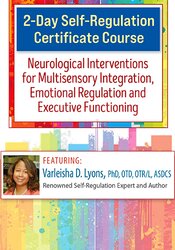
DVD
2-Day Advanced Training!: Neuroscience and Self-Regulation Techniques for Kids with Autism, ADHD & Sensory Disorders
- Average Rating:
- 24
- Faculty:
- Varleisha Lyons, PhD, OTD, OTR/L, ASDCS
- Duration:
- 11 Hours 45 Minutes
- Copyright:
-
Apr 25, 2019
- Publisher:
- PESI Inc.
- Product Code:
- RNV063420
- Media Type:
- DVD

Description
Watch Varleisha Gibbs, PhD, OTD, OTR/L, renowned self-regulation expert and author for this intensive 2-day training and learn clinically proven neurological approaches to addressing self-regulation in children and adolescents diagnosed with Autism, Sensory Processing Disorder, and ADHD. Knowing the underlying brain connections will help you better select and develop appropriate interventions for challenging behaviors, such as hyper-activity, hypo-activity, aggressiveness, self-stimulatory and inattentiveness.
You will walk away with neurologically tailored sensory strategies, cutting-edge treatment techniques, and sensory equipment strategies, including, mindfulness, social skill programs, music and movement, and respiratory-based techniques.
On day one, you will learn the underlying neurological components to connect the brain to clinical practice through:
- Brain dissection video wet labs, neuroanatomy, pathways, and function
- Autonomic nervous system and its connection to stress, fear, and primitive reflexes
- Video examples of children in a sensory clinic demonstrating positive outcomes when equipment is used appropriately
The second day, you will learn how to analyze and apply treatment techniques, such as:
- Activating the vagus nerve and the nervous system for regulation
- Addressing primitive reflexes and improve social skills and age appropriate behaviors
- Incorporating a mindfulness program for self-regulation
- Applying your knowledge through the use of video case studies to examine the evaluation process, treatment planning, goal development, and re-assessment of children displaying challenging social, eating, and sleeping behaviors
Whether you are an expert on the brain or new to this science, Dr. Gibbs makes it easy to understand and easy to implement. You will leave ignited by revelations exposed in Dr. Gibbs’ presentation!
Credit
Faculty

Varleisha Lyons, PhD, OTD, OTR/L, ASDCS Related seminars and products
Varleisha D. Lyons (formerly Gibbs), PhD, OTD, OTR/L, ASDCS, is an occupational therapist and author with over 20 years of experience working with children and adolescents diagnosed with Autism Spectrum Disorder, sensory processing disorders and neurological disorders. She developed and founded Delaware’s first occupational therapy program and became the first black indigenous American woman to serve as the Scientific Programs Officer at the American Occupational Therapy Foundation.
Varleisha continues to lecture and provides training on sensory processing strategies and self-regulation to practitioners, parents, and teachers throughout the country and internationally. As co-author of Raising Kids with Sensory Processing Disorders, she has provided families with strategies to understand and care for their children. Dr. Lyons is the developer of the Self-Regulation and Mindfulness program and author of the best-selling book, Self-Regulation and Mindfulness: Exercises and Worksheets for Sensory Processing Disorder, ADHD, and Autism Spectrum Disorder (PESI Publishing & Media). She is the co-author of Trauma Treatment in ACTION: Over 85 Activities to Move Clients Toward Healing, Growth and Improved Functioning (PESI Publishing & Media). Her areas of expertise include neuroanatomy, self-regulation strategies across the lifespan, health inequities, and trauma responsive approaches.
Disclaimer: The views, thoughts, and opinions expressed in this presentation belong solely to the author, and not necessarily to the author's employer, organization, committee or other group or individual. Varleisha D. Lyons PhD, OTR/L is employed by the American Occupational Therapy Association (AOTA). This work is independent of her role and not affiliated with AOTA, Inc.
Speaker Disclosures:
Financial: Dr. Varleisha Lyons maintains a private practice and is the founder and CEO of Wasut Sanctuary & Education, LLC. She receives royalties as a published author. Dr. Lyons receives a speaking honorarium, recording and book royalties from PESI, Inc. She has no relevant financial relationships with ineligible organizations.
Non-financial: Dr. Varleisha Lyons is a member of the American Occupational Therapy Association and the National Black Occupational Therapy Caucus. She serves as a board member of the National Association for Hearing and Speech Action.
Additional Info
Access for Self-Study (Non-Interactive)Access never expires for this product.
Outline
The Neuroscience Behind Self-Regulation
- A look at sensory-motor pathways
- Brain dissection video: The emotional brain and its connection to executive functioning
- Neurological dysfunction: Hyper-activity, hypo-activity, aggressiveness, self-stimulatory, and inattentiveness
Neuro and Sensory Integration: Linking to Behaviors
- Breaking down self-regulation: Sensory, cognition and emotions
- Self-regulation effects on behavior: Flapping, inflexibility, rigidity, lack of inhibition, poor social skills, risk taking
- The power of the autonomic nervous system and its connection to behavior (ie. stress, fear and primitive reflexes)
- The power of primitive reflexes and how they impede on function
- Tools and strategies for assessing primitive reflexes
Video Case Study Analyzation: Aligning Symptoms and Characteristics with Appropriate Interventions
- ADHD: Diagnosis and current treatment strategies
- Autism: Diagnosis and DSM-5® updates
- Sensory Processing Disorder (SPD):
- Sensory modulation disorder
- Sensory-based motor disorder
- Sensory discrimination disorder
Self-Regulation Techniques and the Vagus Nerve Connection
- Communication strategies that provide control: Symbolic and non-verbal
- Self-management and behavioral strategies: Behavioral contracts, checklist for tracking behaviors, video modeling
- Addressing picky eating and poor sleep habits: Desensitizing and non-threatening activities
- Music as a technique to initiate sensorial stimuli, calming and attentiveness
- New interventions for vestibular, proprioceptive, auditory, smell and vision work
Apply Neuroscience to Interventions: Hands-on Activities
- Neurological connection of current programs such as Brain Gym®, sensory diets, and MeMoves™, just to name a few!
- Integrate a mindfulness program for self-regulation
- Address primitive reflexes and improve social participation and age appropriate behaviors
- Tool to assess child’s arousal levels to be used for daily schedules and to organize daily interventions
Treatment Planning: Video Case Examples of Children Displaying Challenging Social, Eating and Sleep Behaviors
- Perform a virtual evaluation
- Develop a treatment plan
- Goal development
- Re-assessment: When is it needed and when to discharge
Psychoeducation for Clients and Parents
- Evidence-based intervention and techniques to address challenges with self-regulation
- Address psychosocial concerns and experiences of caregivers of children with self-regulation challenges
- Communicate methods to address reciprocal regulation between the child and caregiver to address the influences and interaction each have
Objectives
- Analyze the neuroscientific research related to self-regulation and sensory processing in kids diagnosed with Autism, Sensory Processing Disorder, and ADHD.
- Differentiate between the characteristics of sensory processing disorder, ADHD and autism and articulate how the neurological processes of each disorder coincide with one another.
- Apply neurological approaches that tap into the central, autonomic, and enteric nervous systems to improve clinical intervention techniques.
- Determine the role of primitive reflexes and how they support or impede client functioning.
- Evaluate the relationship between the autonomic nervous system and behavior in clients.
- Determine the neurological responses aligned with intervention techniques to further enhance treatment planning.
- Develop appropriate clinical interventions for challenging behaviors in clients, such as hyper-activity, hypoactivity, aggressiveness, self-stimulation and inattentiveness.
- Implement music as a technique to initiate sensorial stimuli, calming and attentiveness in clients.
- Integrate a comprehensive mindfulness program to improve self-regulation in clients.
- Utilize role play activities to assess levels of arousal among clients.
- Develop a comprehensive treatment plan that addresses a variety of clinical concerns, including social skills deficits, picky eating and sleeping issues.
- Implement strategies to address reciprocal regulation between the child and caregiver in order to improve clinical outcomes.
Target Audience
- Occupational Therapists
- Occupational Therapy Assistants
- Speech-Language Pathologists
- Counselors
- Social Workers
- Educators
- Marriage & Family Therapists
- Physical Therapists
- Physical Therapist Assistants
- Psychologists
Reviews
| 5 |
|
| 4 |
|
| 3 |
|
| 2 |
|
| 1 |
|
Overall: 5
Total Reviews: 24
Satisfaction Guarantee
Your satisfaction is our goal and our guarantee. Concerns should be addressed to: PO Box 1000, Eau Claire, WI 54702-1000 or call 1-800-844-8260.
ADA Needs
We would be happy to accommodate your ADA needs; please call our Customer Service Department for more information at 1-800-844-8260.
Please wait ...