

Digital Seminar
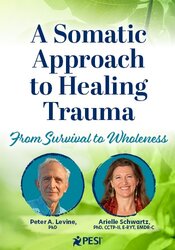
A Somatic Approach to Healing Trauma: From Survival to Wholeness
- Average Rating:
- Not yet rated
- Faculty:
- Peter A. Levine, PhD | Arielle Schwartz, PhD, CCTP-II, E-RYT, EMDR-C
- Copyright:
-
Nov 11, 2026
- Product Code:
- POS150936
- Media Type:
- Digital Seminar - Also available: Online Course

Description
Trauma doesn’t live in thoughts and narratives—it lives in the body. When survival responses like fight, flight, freeze or collapse don’t complete, they become physiologically encoded, keeping clients stuck in the past regardless of how much they may talk about what happened or how many insights they may have. Dr. Levine, a somatic trauma therapy pioneer, offers a naturalistic and neurobiological framework to assess where clients are “stuck” in defensive states—and to gently release thwarted survival energy at the root of trauma symptoms. In this workshop, through lecture and case examples, you’ll gain practical somatic tools to help your clients move out of chronic dysregulation and toward greater presence, resilience, and ease. You’ll discover how to:
-
Identify where a client is physiologically stuck in a survival response
-
Apply core somatic techniques like somatic tracking, titration, and pendulation
-
Support clients in building self-regulation and coregulation capacities
-
Recognize clinical risks in somatic work
Credit
Faculty

Peter A. Levine, PhD Related seminars and products
Peter A. Levine, PhD, holds doctorates in both medical biophysics and psychology. The developer of Somatic Experiencing®, a body-awareness approach to healing trauma, and founder of the Somatic Experiencing Trauma Institute, which conducts trainings in this work throughout the world and in various indigenous cultures, with 26 faculty members and over five thousand students. Dr. Levine was a stress consultant for NASA on the development of the space shuttle project and was a member of the Institute of World Affairs Task Force of Psychologists for Social Responsibility in developing responses to large-scale disasters and ethnopolitical warfare. Levine’s international best seller, Waking the Tiger: Healing Trauma, has been translated into 22 languages. His recent interests include the prevention of trauma in children, and he has co-written two books, with Maggie Kline, in the area: Trauma Through a Child’s Eyes and Trauma-Proofing Your Kids. His most recent book: Trauma and Memory: Brain and Body in a Search for the Living Past, was recently released to rave reviews. Levine’s original contribution to the field of body psychotherapy was honored in 2010 when he received the Lifetime Achievement Award from the United States Association for Body Psychotherapy (USABP). Levine was also honored as the recipient of the 2020 Psychotherapy Networker Lifetime Achievement Award.
Speaker Disclosures:
Financial: Dr. Peter Levine is the founder and president of the Ergos Institute of Somatic Education, the president and editorial director of Ergos Institute Press, and receives a consulting fee from the Meadows Addiction Center. He receives royalties as a published author. Dr. Levine receives a speaking honorarium, recording, and book royalties from Psychotherapy Networker and PESI, Inc. He has no relevant financial relationships with ineligible organizations.
Non-financial: Dr. Peter Levine is a senior clinical fellow and advisor to the Meadows Addiction Treatment Center. He is a member of the American Psychological Association, the Humanistic Psychological Association, and the International Society for Traumatic Stress Studies.

Arielle Schwartz, PhD, CCTP-II, E-RYT, EMDR-C Related seminars and products
Arielle Schwartz, PhD, CCTP-II, E-RYT, EMDR-C, is a licensed clinical psychologist, certified complex trauma professional, EMDR Consultant, and Kripalu yoga teacher. She is an internationally sought-out speaker, leading voice in the field of trauma recovery, and the author of eight books including The Complex PTSD Workbook, EMDR Therapy and Somatic Psychology, The Post-Traumatic Growth Guidebook, and Applied Polyvagal Theory in Yoga.
As the founder of the Center for Resilience Informed Therapy, her work is rooted in the positive psychology movement, which is focused on enhancing resources and fostering growth. She offers an integrative, mind-body approach to therapy that includes relational therapy, somatic psychology, EMDR therapy, parts work therapy, and therapeutic yoga for trauma. Praised by Dr. Stephen Porges, Arielle specializes in applying his polyvagal theory, which focuses on addressing imbalances within the autonomic nervous system that underlie most mental and physical health conditions. Her work can be found at the Shift Network, Sounds True, Psychotherapy Networker, Embody Lab, Art of Living, Omega Institute, and more.
Speaker Disclosures:
Financial: Dr. Arielle Schwartz maintains a private practice, has an employment relationship with Integrative Psychiatry Institute and receives compensation as a yoga instructor. She receives royalties as a published author and receives compensation as an international presenter and a yoga instructor. Dr. Schwartz is a paid consultant for Evergreen Certifications. She receives speaking honorarium, recording, and book royalties from PESI, Inc. She has no relevant financial relationships with ineligible organizations.
Non-financial: Dr. Arielle Schwartz is a member of the American Psychological Association and the Yoga Alliance.
Outline
Understand Trauma as a Physiological Phenomenon
- Defensive survival responses (fight, flight, fawn, freeze, collapse)
- How trauma becomes “stuck” in nervous system, independent of narrative memory
- Distinguishing trauma as physical encoding vs. cognitive interpretation
The Nervous System in Somatic Trauma Work
- Bottom-up vs. top-down processing: Implications for intervention
- Interoception, proprioception, and autonomic regulation
- Identifying patterns of dysregulation in clinical assessment
Somatic Interventions and Regulation Strategies
- Techniques: Somatic tracking, titration, pendulation
- Case examples illustrating process: Gentle facilitation of completion of defensive responses
- Support clients in expanding capacity for co-regulation and self-regulation
Clinical Considerations, Limitations and Risks
- Acknowledgement of limitations of research evidence
- Potential risks: Overwhelm during somatic activation without sufficient support, ethical considerations in non-verbal somatic work
- Contraindications: Clients with unmanaged dissociation, medical instability, or limited support systems
Objectives
- Define how trauma responses are a set of defensive bodily reactions meant to protect us and how they may present in a patient.
- Identify how trauma-based perceptions remain fundamentally unchanged until the internal experience of the body changes.
- Demonstrate various techniques to aid nervous system regulation.
Target Audience
- Social Workers
- Counselors
- Psychologists
- Psychotherapists
- Addiction Counselors
- Marriage & Family Therapists
- Behavioral Health Nurses
- Psychiatrists
- Other Mental Health Professionals
Reviews
Satisfaction Guarantee
Your satisfaction is our goal and our guarantee. Concerns should be addressed to: PO Box 1000, Eau Claire, WI 54702-1000 or call 1-800-844-8260.
ADA Needs
We would be happy to accommodate your ADA needs; please call our Customer Service Department for more information at 1-800-844-8260.
Please wait ...