

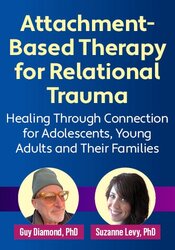
Digital Seminar
Attachment-Based Therapy for Relational Trauma
Healing Through Connection for Adolescents, Young Adults and Their Families
- Average Rating:
- 76
- Faculty:
- Guy Diamond, PhD | Suzanne Levy, PhD
- Duration:
- 6 Hours 27 Minutes
- Format:
- Audio and Video
- Copyright:
-
May 06, 2026
- Product Code:
- NOS096589
- Media Type:
- Digital Seminar
Description
Repair relational trauma as it happens – and help young people and their families build stronger, more secure connections.
When it comes to parent-child relationships, ruptures are inevitable, but the long-term impact of unresolved attachment wounds doesn’t have to be.
Imagine having the tools to help address clients’ feelings of insecurity, worthlessness, isolation and emotional turmoil by strengthening attachment in the very relationships where the pain begins. That’s what makes Attachment-Based Family Therapy (ABFT) so powerful. It gives you a practical, step-by-step framework for guiding adolescents, parents and families through meaningful repair in the here and now – not years from now.
Watch ABFT founders Drs. Guy Diamond and Suzanne Levy in this one-day training, and discover how to:
- Turn conflict into connection with a structured, step-by-step process for repairing ruptures, past and present.
- Empower clients to express vulnerability and seek comfort instead of withdrawing or acting out.
- Guide parents from reactivity to empathy, creating space for trust, openness and safety.
- Build new relational patterns grounded in closeness, responsiveness, and safety.
You’ll walk away with a powerful, research-informed roadmap to help clients repair relational wounds when they happen -- strengthening emotional safety, restoring trust, and promoting greater relational security in their most important relationships.
Attachment Based Family Therapy (ABFT) is a powerful approach that helps clients heal through connection.
Grounded in attachment science and family systems, ABFT gives therapists a step-by-step roadmap for repairing ruptures, rebuilding trust, improving communication, and creating real emotional safety in relationships.
With more than two decades of clinical research behind it, ABFT has been shown to reduce depression, anxiety, suicidality, self-harm, and relational conflict - because it goes beyond surface-level change to help relationships heal from the inside out.
Originally developed for adolescents and their families, ABFT is now being used by therapists working with teens, young adults, parents, couples, and families - bringing the same attachment-focused, present-moment healing to a wide range of clients.
This training offers a rare opportunity to learn an evidence-based approach that will transform how you think about attachment and healing
—and empower you to guide clients through real-time repair that strengthens their most important relationships.
Credit
Faculty

Guy Diamond, PhD Related seminars and products
Guy Diamond, PhD, is Professor Emeritus at the University of Pennsylvania School of Medicine and was Associate Professor at Drexel University in the College of Nursing and Health Profession until he retired in 2023. At Drexel, he was the Director of Center for Family Intervention Science (CFIS). His primary work has been in the area of youth suicide prevention and treatment research. On the prevention side, he has created a program focused on training, screening and triage to be implemented in non-behavioral health settings. On the treatment side, he has focused on the development and testing of attachment-based family therapy (ABFT), especially for teens struggling with depression and suicide. ABFT has now been applied to children, young adults, LGBTQ youth and adults, and adopted in clinics all over the world where it is used as a transdiagnostic approach to patient mental health and ruptures in family attachment. Dr. Diamond is now president of the ABFT International Training Institute, which disseminates this model around the world.
Speaker Disclosures:
Financial: Guy Diamond is the Co-Developer an of ABFT and the President of ABFT International. He is Professor Emeritus of the University of Pennsylvania School of Medicine. Guy Diamond receives a grant from SAMHSA. He has no relevant financial relationships with ineligible organizations.
Non-financial: Guy Diamond is a fellow with the American Psychological Association and member of the American Association for Marriage and Family Therapy. He serves on the editorial board for Family Process and Couple and Family Psychology. He is a presenter with Psychotherapy Networker.

Suzanne Levy, PhD Related seminars and products
Dr. Suzanne Levy is an internationally recognized licensed clinical psychologist and a leading expert in adolescent mental health and family therapy. She is the co-developer of Attachment-Based Family Therapy (ABFT), a manualized, empirically supported treatment model designed to address adolescent depression and suicide by strengthening family relationships.
Dr. Levy is the CEO and co-founder of the ABFT International Training Institute, LLC, where she leads global efforts to train clinicians in ABFT. Previously, she served as the executive director of Strategic Initiatives and Training for the ABFT Training Program at Drexel University, and before that, as the ABFT training director at the Children’s Hospital of Philadelphia.
Since 2007, Dr. Levy has conducted ABFT training workshops and supervision for clinicians across the US and internationally. She is sought-after speaker and has presented extensively on topics including ABFT, emotion coaching, adolescent development, depression, resilience, and substance use. Dr. Levy is also the co-author, alongside Drs. Guy and Gary Diamond, of the seminal book Attachment-Based Family Therapy for Depressed Adolescents, published by the American Psychological Association.
Speaker Disclosures:
Financial: Suzanne Levy is the Co-founder and CEO of ABFT International Training Institute, LLC and has employment relationships with Queensland University of Technology, Central Toronto Youth Services, Deschutes County Mental Health, Asster Hospital, Newport Healthcare, and ISP. She receives a speaking honorarium from Peace at Home, Ohel, and TZK Seminars and receives royalties from the American Psychological Association. She has no relevant financial relationships with ineligible organizations.
Non-financial: Suzanne Levy is a member of the American Psychological Association and he Pennsylvania Psychological Association. She is a contributing author with Psychotherapy Networker.
Additional Info
Additional CE InfoFor a more detailed outline that includes times or durations of time, if needed, please contact cepesi@pesi.com.
Objectives
- Examine the theoretical foundation of ABFT.
- Identify the five treatment task structure of the model.
- Determine how to engage family members in strengthening their relationship as the first goal of therapy
- Identify strategies for helping youth explore the impact of their attachment wounds.
- Determine methods for facilitating parental empathy toward their child.
- Utilize in-session enactments to enhance relational repair.
Outline
Introduction, Theory, Clinical Model and Supporting Research
- Contributors to healthy youth functioning
- Attachment security and emotion regulation
- Parenting skills for secure attachment and emotion regulation
- The impact of relational trauma
- ABFTs Theory of mental health distress
- Theory of change and Earned Security
- Empirical support for ABFT
- Clinical Model
Task I: Relational Frame
- Joining and understanding the presenting problem
- Setting the relational reframe
- Contracting for relational repair
Task II: Therapy with a Young person
- Skills for connecting with the young person
- Exploring the attachment narrative
- Connecting ruptures and mental health
- Preparing youth to talk with parents
Task III: Working with Parents to improve parenting
- Engaging caregivers
- Understanding how current stressors affect parenting
- Exploring and improving parental teamwork
- Exploring caregivers’ own attachment history
- Developing new parenting skills
- Preparing caregivers to address ruptures with youth
Task IV: Attachment Task
- Understanding the power and processes of in session, direct conversation
- How to shape productive conversations
- How to keep the conversation focused on attachment ruptures and injury
Task V: Autonomy Promoting Task
- Helping parents provide attachment security while promoting independence and competency
- How to facilitate attachment promoting conversations when discussing day-to-day problems
Target Audience
- Case Workers
- Counselors
- Couple and Family Therapists
- ER Physicians
- Health Care Administrators
- Frontline MH staff
- Primary Care Physicians
- Psychiatrists
- Psychiatric Nurses
- Psychologists
- Psychotherapists
- SAP Team members
- Social Workers
- Other Mental Health Professionals
Reviews
| 5 |
|
| 4 |
|
| 3 |
|
| 2 |
|
| 1 |
|
Overall: 4.9
Total Reviews: 76
Satisfaction Guarantee
Your satisfaction is our goal and our guarantee. Concerns should be addressed to: PO Box 1000, Eau Claire, WI 54702-1000 or call 1-800-844-8260.
ADA Needs
We would be happy to accommodate your ADA needs; please call our Customer Service Department for more information at 1-800-844-8260.
Please wait ...