

Digital Seminar
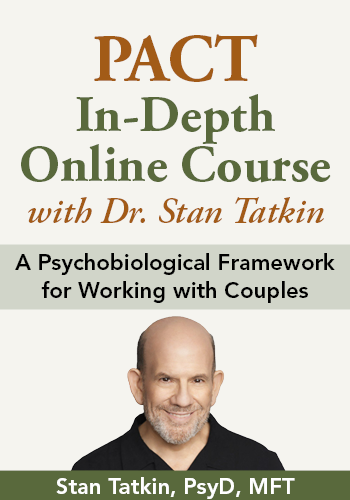
PACT 2-Day Workshop with Stan Tatkin: A Psychobiological Framework for Working with Couples
- Average Rating:
- 73
- Faculty:
- Stan Tatkin, PsyD, MFT
- Duration:
- 12 Hours 46 Minutes
- Format:
- Audio and Video
- Copyright:
-
Sep 23, 2026
- Product Code:
- NOS096773
- Media Type:
- Digital Seminar

Description
Couples frequently enter therapy stuck in repetitive conflict, emotional distance, or cycles of escalation and withdrawal. Despite insight, motivation, and communication skills, many couples fail to change. Traditional models often underestimate the impact of neurobiological stress responses, developmental capacity limits, and attachment-based survival strategies that dominate under threat.
This two-day introductory program presents the Psychobiological Approach to Couple Therapy (PACT)—a model that integrates attachment theory, arousal regulation, and developmental neuroscience to explain why couples behave as they do under stress and how therapists can intervene more effectively at the level of the two-person system.
Participants will learn to shift clinical attention from narrative content and problem-solving toward real-time interaction, physiological state, and observable behavior. Emphasis is placed on understanding secure versus insecure functioning, developmental constraints on regulation and executive functioning, therapist stance, and the conditions under which insight-oriented or skills-based interventions fail.
This program is conceptual and observational in nature. It is designed to enhance clinical understanding, assessment, and decision-making rather than to provide step-by-step instruction or certification in PACT methods. Discussion includes clinical applications, ethical considerations, limitations of the research, and potential risks associated with psychobiological approaches to couple therapy.
Credit
Faculty

Stan Tatkin, PsyD, MFT Related seminars and products
Stan Tatkin, PsyD, MFT, is a clinician, researcher, teacher, and developer of a Psychobiological Approach to Couple Therapy (PACT). He teaches and supervises family medicine residents at Kaiser Permanente, Woodland Hills, CA, and is an assistant clinical professor at the UCLA David Geffen School of Medicine, Department of Family Medicine.
Speaker Disclosures:
Financial: Stan Tatkin is the founder and director of the PACT Institute and has employment relationships California Lutheran University and the Santa Barbara Graduate Institute. He receives compensation as a national speaker, couples retreat leader and royalties as a published author. Stan Tatkin receives book royalties from Psychotherapy Networker and PESI, Inc. He has no relevant financial relationships with ineligible organizations.
Non-financial: Stan Tatkin has no relevant non-financial relationships.
Additional Info
Questions?Visit our FAQ page at www.pesi.com/faq or contact us at www.pesi.com/info
Objectives
- Analyze couple conflict using a psychobiological framework integrating attachment, arousal regulation, and developmental neuroscience.
- Differentiate secure-functioning from insecure-functioning couple systems based on observable interaction patterns.
- Identify indicators of hyperarousal, hypoarousal, and collapse during couple therapy sessions.
- Evaluate how developmental capacity and stress-related regression affect couple functioning.
- Assess the impact of memory and perceptual bias on repetitive relational conflict.
- Apply principles of arousal regulation to clinical decision-making in high-conflict couples.
- Distinguish content-based disputes from state-driven relational breakdowns.
- Evaluate therapist stance variables that influence stabilization or escalation in couple therapy.
- Integrate a two-person system framework into couple case conceptualization.
- Assess the role of attachment strategies in pursuit, withdrawal, and escalation patterns.
- Evaluate clinical risks associated with premature insight-oriented or confrontational interventions.
- Communicate limitations, risks, and alternatives of psychobiological couple interventions to clients.
Outline
I. Psychobiological Foundations of Couple Distress
-
Attachment strategies as survival adaptations
-
Arousal regulation and autonomic nervous system states
-
Developmental neuroscience and regulatory capacity
-
Memory, state, and perceptual bias under stress
-
Clinical implications for assessment and intervention timing
II. Secure vs. Insecure Functioning in Adult Relationships
-
Secure functioning as a two-person system
-
Mutuality, fairness, and shared purpose
-
Pro-self versus pro-relationship behavior
-
Breakdown patterns in insecure-functioning couples
-
Clinical decision-making guided by secure-functioning principles
III. Clinical Observation and Therapeutic Stance
-
Tracking interaction rather than narrative content
-
Reading somatic, behavioral, and relational cues
-
Therapist regulation and countertransference management
-
System-level versus individual-level interventions
-
Application to conflict, withdrawal, and escalation
IV. Clinical Application, Limitations, and Risks
-
Application to chronic conflict, thirds, and betrayal
-
Developmental and neurobiological contraindications
-
Limitations of the current research base
-
Risks of misapplication or partial implementation
-
Ethical considerations and informed consent
Target Audience
- Psychologists
- Physicians
- Nurses
- Counselors
- Marriage and Family Therapists
- Addiction Counselors
- Social Workers
Reviews
| 5 |
|
| 4 |
|
| 3 |
|
| 2 |
|
| 1 |
|
Overall: 4.8
Total Reviews: 73
Satisfaction Guarantee
Your satisfaction is our goal and our guarantee. Concerns should be addressed to: PO Box 1000, Eau Claire, WI 54702-1000 or call 1-800-844-8260.
ADA Needs
We would be happy to accommodate your ADA needs; please call our Customer Service Department for more information at 1-800-844-8260.
Please wait ...