

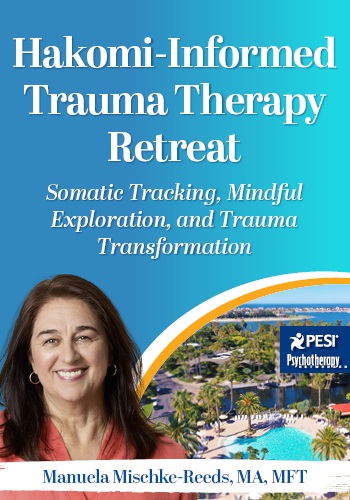
Digital Seminar
Hakomi-Informed Trauma Therapy Retreat
Somatic Tracking, Mindful Exploration, and Trauma Transformation
- Average Rating:
- Not yet rated
- Faculty:
- Manuela Mischke-Reeds, MA, LMFT
- Duration:
- Approx. 12 Hours
- Copyright:
-
Mar 25, 2027
- Product Code:
- POS096772
- Media Type:
- Digital Seminar - Also available: In-Person Seminar | Live Webcast

Description
Every clinician has a list. The clients who do everything right and still don't progress.
You know what it looks like: the shallow breath, the jaw that never unclenches, the moment they go distant right when it matters most.
That gap is not a failure of effort. It is a failure of method.
Trauma lives in the body, in the nervous system still running a protection response against a threat that ended long ago. If you aren't working with the body, you're working around the trauma, not through it.
You need the Hakomi method.
Hakomi-informed trauma therapy is a complete therapeutic language whose principles change how you listen, what you track, and where you intervene. Used by leading trauma therapists worldwide, it is also one of the most undertrained methods in the field.
This immersive CE training changes that, led by Manuela Mischke-Reeds, MA, MFT, one of the world’s most renowned Hakomi experts. She doesn't just teach the Hakomi model. She embodies it.
"Manuela Mischke-Reeds has a compassionate voice that imbues her very precise somatic interventions and suggestions with warmth and clinical wisdom."
— Janina Fisher, PhD, World-Renowned Trauma Expert and Author
The clients on your list deserve better. This training is where that changes.
Purchase now!
Credit
Faculty

Manuela Mischke-Reeds, MA, LMFT Related seminars and products
Manuela Mischke-Reeds, MA, MFT, is a somatic trauma psychotherapist, author, international teacher of somatic psychology, and senior Hakomi trainer. She is the founder of Embodywise, an international learning community offering professional training in trauma therapy, somatic psychology, and the Hakomi Method, and is a co-founder of the Hakomi Institute of California.
She is the developer of the Innate Somatic Intelligence Trauma Therapy Approach (ISITTA), an integrative somatic psychotherapy framework that supports trauma recovery through nervous system regulation, embodied awareness, movement-based integration, and relational therapeutic processes.
With over 30 years of clinical experience, Manuela has taught professional training programs internationally across North America, Europe, Asia, and Australia. In the field of psychedelic therapy, she offers specialized somatic approaches, including somatic therapy techniques, movement-based integration, and ethical touch practices, to support psychedelic-assisted psychotherapy through a trauma-informed, relational lens.
She is the author of several books, including Embodied Psychedelic Therapy: A Somatic Guide (W. W. Norton, with Joshua Sylvae), Somatic Psychotherapy Toolbox (PESI), Trauma-Sensitive Movement (PESI), and 8 Keys to Practicing Mindfulness (W. W. Norton).
She is also a contributing author to Hakomi Mindfulness-Centered Somatic Psychotherapy: A Comprehensive Guide to Theory and Practice (W. W. Norton), The Complete Trauma Treatment Guide (PESI), and The Praeger Handbook of Community Mental Health Practice (Praeger), for which she authored the chapter "The Role of Trauma in Community Health: A Somatic Perspective."
Speaker Disclosures:
Financial: Manuela Mischke-Reeds is the founder of Embodywise and has an employment relationship with Embodylab. She receives compensation as a consultant and royalties as a published author. She receives a speaking honorarium, recording, and book royalties from PESI, Inc. She has no relevant financial relationships with ineligible organizations.
Non-financial: Manuel Mischke-Reeds has no relevant non-financial relationships.
Additional Info
Access for Self-Study (Non-Interactive)Access never expires for this product.
For a more detailed outline that includes times or durations of time, if needed, please contact cepesi@pesi.com.
Questions?
Visit our FAQ page at www.pesi.com/faq or contact us at www.pesi.com/info.
Objectives
- Utilize the 5 principles of Hakomi in clinical practice.
- Determine the interventions used to access the unconscious in treatment.
- Describe at least three types of the Therapist Seat used to facilitate treatment.
- Utilize the Back-Body Practice before and during a session to enhance therapeutic awareness and engagement.
- Construct effective Contact Statements.
- Utilize tracking with clients to help access core material.
- Identify three types of mindful explorations that enhance clinical work.
- Evaluate how the Hakomi method is used to facilitate the healing process.
- Examine the application of foundational Polyvagal concepts within the Hakomi framework for trauma treatment.
- Describe how to use three types of somatic resources to facilitate self-regulation in session.
- Summarize the theory of how parts are formed and healed with a Hakomi approach.
- Utilize the ROAMING protocol when triggers arise during trauma processing.
- Identify the informed consent requirements and contraindications for safe relational touch in trauma healing.
Outline
Hakomi Principles, Therapeutic Model & Introduction to Somatic Healing
- The five core principles of the Hakomi Method: mindfulness, organicity, non-violence, unity, and mind-body holism
- The Hakomi therapeutic model: session arc, accessing unconscious material, and identifying core material
- Integrating new discoveries, beliefs, and behaviors within the Hakomi framework
- Neuroception and co-regulation: how the therapist's nervous system shapes the therapeutic field
- Foundational concepts of Polyvagal Theory as a neurobiological context for somatic work
The Embodied Therapist
- Principles of Being in the Therapist Seat
- Types of Therapist Seats: when to use each and how to embody each role
- The therapist's regulated nervous system as a co-regulatory resource
- Therapist somatic self-resourcing: the Back-Body Practice, step by step
- Experiential exercise: practicing the Back-Body Practice in pairs
Contacting — Speaking the Language of Hakomi
- What is Contacting, and how does it differ from reflection or interpretation?
- How contact statements work to take clients deeper into present-moment experience
- Contacting across various categories of experience: movement, sensation, emotion, imagery, and thoughts
- Constructing effective contact statements: a comprehensive guide
- Triad practice: therapist, client, and observer roles with group debrief
Somatic Tracking
- The purpose and function of tracking in Hakomi therapy
- What to track: verbal content, tone, pace, breath, gesture, facial expression, and micro-movements
- How to track: the therapist's internal orientation and relational attunement
- Responding to tracked material with precision and care
- Using tracking to discover core material and guide clients toward direct somatic experience
- Live Demonstration: tracking in trauma processing
- Experiential Practice: tracking in pairs with a structured observation guide
Mindful Explorations
- Defining mindful explorations and their role in the arc of Hakomi treatment
- The experiential mindset of the Hakomi therapist: presence, tracking, and non-interference
- Setting up, facilitating, and closing a mindful exploration: consent, framing, and pacing
- Types of mindful explorations and using prompts to deepen client experience
- Live Demonstration: childhood memory and core belief work integrating contacting, tracking, and mindful exploration
Trauma Healing & Somatic Resourcing
- Hakomi's understanding of trauma: how the body holds, organizes, and protects
- Individual, relational, and collective dimensions of trauma and their pathways to healing
- Polyvagal Theory applied to Hakomi: reading autonomic states as a real-time guide for intervention
- Somatic resourcing techniques for stabilization and inner resilience
- When to deepen and when to resource a client's trauma state
- Experiential Practice: Guided somatic resourcing
Working with Internalized Trauma Parts
- What internalized trauma parts are, how they develop, and how they manifest somatically, emotionally, and relationally
- The role of developmental milestones in parts formation
- Hakomi techniques for working with parts: moving from combat to curiosity
- Guided Exercise: All Parts Are Welcome — a somatic inquiry for the group
- Live Demonstration: individual, cultural, and contextual trauma held within the Hakomi frame
Safe, Relational Touch in Hakomi
- Why safe touch can be a powerful element of trauma healing
- The primacy of informed consent and ongoing relational consent
- Parameters for using touch: clinical indications and contraindications
- Language, tracking, and responsiveness during a touch intervention
- Risks and limitations: what to watch for and when to stop
- Video Deconstruction: examining the use of touch in a live Hakomi session
Working with Triggers — The ROAMING Protocol
- Understanding the function of triggers and the body's protective response
- Tracking triggers somatically: early signals, escalation patterns, and resolution
- Cultivating dual awareness: staying present within a triggered state
- The ROAMING Protocol, step by step
- Applied Practice: ROAMING with a clinical scenario
Integration, Small Group Practice & Closing
- Supervised small-group practice of core Hakomi trauma skills with peer observation and feedback
- Clinical edge cases and nuanced scenario discussion
- Consolidating personal learning and identifying next steps for clinical integration
- Somatic closing practice and written integration exercise
Discussion of Risks and Limitations
- Hakomi therapy for trauma
- Polyvagal-Informed Therapy
Target Audience
- Counselors
- Social Workers
- Psychologists
- Psychotherapists
- Therapists
- Marriage & Family Therapists
- Addiction Counselors
- Case Managers
- Physicians
- Nurses
- Other Mental Health Professionals
Reviews
Satisfaction Guarantee
Your satisfaction is our goal and our guarantee. Concerns should be addressed to: PO Box 1000, Eau Claire, WI 54702-1000 or call 1-800-844-8260.
ADA Needs
We would be happy to accommodate your ADA needs; please call our Customer Service Department for more information at 1-800-844-8260.
Please wait ...